Invasive Prosopis trapping flamingos at Lake Bogoria

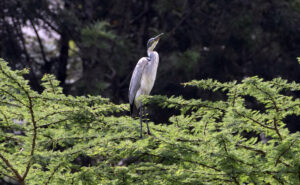
Pink spots across the blue-green water; the low grunting sound of thousands of feeding flamingos in the distance –Lake Bogoria’s alkaline water creates a haven for almost a quarter of the world’s Lesser Flamingos after their breeding season in Tanzania’s Lake Natron.

This year, however, as one nears the shore the scene changes – dozens of flamingo carcasses dangle from the branches of dense Prosopis juliflora thickets that blanket the lake’s shores. Some flamingo seem to have lost the fight after struggling to disentangle from the sharp thorns of the low trees.

“It is worrying,” says James Kimaru, the Kenya Wildlife Service (KWS) senior warden at Lake Bogoria National Reserve. “Tens of flamingos are dying from being trapped by Prosopis bushes while attempting to either land or take off,”

Prosopis juliflora, a kind of mesquite, is an aggressive invader that replaces native vegetation, especially in dry areas where there is seasonal flooding.. It is ranked among top 100 invasive species globally, ravaging other arid and semi-arid areas of Ethiopia, Sudan, Egypt, West Africa, Australia, and other countries.

The plant was introduced in Kenya in the 1970s to rehabilitate the Arid and Semi-Arid Areas (ASALs), due to its resilience, fast growth rate and edible pods. Here it became known as ‘Mathenge’.

Prosopis does not normally grow on the shores of strongly alkaline or saline lakes, and flamingos can use the muddy shores dusted with white soda ash for takeoff and landing. In the past decade of heavy rain and catchment degradation, however, many alkaline lakes have flooded and become fresher. Prosopis became established in the shallow, relatively fresh water along the edges of the lakes.

“Flamingos prefers shallow water near the shores, which unfortunately has been taken over by Prosopis. This becomes a challenge whenever the birds are landing or taking off,” Richard Kipng’eno, Birding and Membership officer at Nature Kenya says.

Lake Bogoria has expanded by 7 square kilometre from its original size. The rising water levels have submerged administration offices and the gate of the \national reserve.

Prosopis has also created navigational challenges in some parts of Lake Baringo,” Kipng’eno adds. “During the recent waterbird counts at Lake Baringo, we experienced some difficulties in manoeuvring boats through the Prosopis thickets.”

Large concentrations of Prosopis are to be found in Tana River, Turkana and Baringo counties. The invasive Prosopis has also colonised parts of Taita Taveta, Malindi, Samburu, Isiolo, Mandera, Marsabit, Wajir, Kajiado and Migori counties.

The plant has also been documented to have invaded some of Kenya’s important wetlands including River Tana Delta in Tana River County, Lorian Swamp (Isiolo/Garissa Counties) Lengurruahanga swamp (Kajiado) among others.

Prosopis charcoal is highly rated, but it is very difficult to cut the hard wood of the spreading, thorny trees.

Lesser Flamingos turning up in unexpected places, including sewage treatment plants

Water levels continue to rise in the Rift Valley lakes. As a result, the alkalinity of some of the lakes is dropping. Changes in the lakes’ chemistry are causing a shift in the ecology of alkaline lakes, whose pH levels have decreased. The adjacent terrestrial habitats have also been affected, with large portions submerged in water. This impacts the carrying capacity for larger mammals in small, fenced protected areas like Lake Nakuru National Park.

Birds are key indicator species of changes in the environment. During the January waterbird census, large flocks of flamingos were observed at the oxygenation ponds in Nakuru, and a smaller flock at the Dandora sewage treatment plant in Ruai, Nairobi. This suggests that flamingos are seeking alternative habitats because of reduced food supply in the alkaline lakes.

At the Nakuru Sewage Treatment plant sitting adjacent to Lake Nakuru, more Lesser Flamingos were observed than on Lake Nakuru itself. Out of the total 6,000 Lesser Flamingos counted on both the ponds and the lake, 4,000 birds were recorded at the sewage treatment ponds. The Dandora treatment ponds recorded 40 Lesser Flamingos.

Waste stabilization ponds are well-suited for the tropics thanks to the high intensity of the sunlight and high temperatures which are important in the wastewater treatment processes. If other counties work towards achieving efficient wastewater treatment processes, especially for the urban centres, there could be alternative feeding habitat for Lesser Flamingos in times of crisis.

During January, Lesser Flamingos have also been reported on Lake Ol’Bolossat – a freshwater lake in Nyandarua County – in Amboseli National Park, on Athi Dam in Nairobi National Park, and on Lake Simbi Nyaima, Nyangweso Irrigation scheme and Ondago swamp in Homa Bay county.

The Waterbird census should be conducted consistently at traditional counting sites and observers should report opportunistic feeding areas for Lesser Flamingos in the country.

Cut one, plant two

One of the results of deforestation is global warming. Trees and plants take in carbon dioxide and release oxygen back into the air. When we cut trees, a lot of the carbon dioxide released finds its way into the atmosphere. The carbon combines with other gases and absorbs sunlight. Normally, the radiation is supposed to escape into space but these gases, which last up to centuries, trap the heat in the atmosphere and causes the planet to get hotter. This is known as the greenhouse effect.

At St. Andrews Preparatory School, Turi, we are always encouraged to do something that would benefit the community, so I decided to plant some trees to help reduce the amount of deforestation and its impacts on our atmosphere. At school, we have a program called ‘Love in Action’. As part of this program, we eat simple lunches and wear our home clothes. We also contribute Ksh.100 from our tuck money to give to the people in need at the school’s charity, the Turi Children’s Project.

We also try and reduce, if not eliminate, food wastage. With less wastage, there would be less need for more land for agriculture. This would reduce deforestation. More land would also be available for the planting of trees.

People also cut down trees for fuelwood for cooking and to make homes warm. Trees also provide timber used for furniture and building. This means that we need to use trees sustainably, by planting as much as or more than we cut down. That’s why I decided to be part of the solution and plant trees, not of the problem by cutting them down.

Because of their many uses, we cannot stop cutting down trees completely. For that matter, for every tree we cut down, we should plant one or two in return. That way, we will continue to use trees sustainably for timber and fuelwood. That way, we will have a win-win situation.

Patricia Owiyo is a budding 11-year-old naturalist who is on a mission to conserve Kenya’s foresst. Patricia is a pupil at St Andrew’s Preparatory School Turi, Nakuru. The disruption of the school calendar by the Covid-19 pandemic made her come up with an initiative to grow trees in degraded forests. Patricia funds her tree-growing activities from savings made from sales of her handicrafts. Last month Patricia donated 400 tree seedlings to the Kijabe Environmental Volunteers (KENVO) for planting in Kereita forest, Kikuyu escarpment. Through friends, Patricia was also linked to Nature Kenya for support and guidance in her dream journey to grow at least 1,000 trees by 2021.

Improving livelihoods in the Yala Ecosystem through chicken farming

You are likely to find indigenous chicken or Kuku Kienyeji on almost all menus in the eateries you visit. Many years of research and improvements on indigenous chicken breeds have made them one of Kenya’s most sought-after delicacies and rearing them a popular business undertaking. Improved local chicken breed possesses characteristics like their ability to thrive in different weather conditions, resistance to diseases, and improved growth rates, which allows it to favorably compete with exotic breeds.

The latest entrant into the chicken rearing business is a group of 50 women from Rawalo Village in Gem sub-county, Siaya County. This follows the operationalization of the poultry production unit constructed by Nature Kenya, with funding from the Darwin Initiative, through the Yala Ecosystem Site Support Group. The unit has a capacity of rearing 600 chickens. The three main functions of the unit will be incubation of chicks, rearing of chickens, and collection of eggs for sale. Brooder equipment including feeders and drinkers have been procured and 150 improved kienyeji chicks; 100 White Leghorn and 50 Kuroiler chicks delivered to kick-start the project.

“The first batch of chicks will be reared up to two months before being distributed to beneficiary farmers. Eggs produced by layers will be sold either for consumption or to local farmers for hatching to improve local breeds,” explains Emily Mateche, Nature Kenya’s Project Officer based in Siaya.

Nature Kenya has been at the forefront of initiating, developing, and diversifying sustainable nature-based enterprises in partnerships with local communities in Important Bird Areas (IBAs). The aim of such initiatives is to improve community livelihoods and support local conservation activities of the sites. These enterprises also provide alternatives to unsustainable livelihood options detrimental to the IBAs and have helped reduce over-dependence on nature products for livelihoods. Nature Kenya has successfully implemented similar ventures in Dakatcha Woodland and in Tana Delta.

“Our main objectives for establishing the chicken rearing business is to improve the household diet and income for the members of the local community. We also want to give women an alternative livelihood source to ease their reliance on natural resources to make a living,” says Emily.

To manage the chicken business, the chicken farmers have constituted a Chicken Business Sub-committee whose role is to develop internal business targets for the chicken rearing enterprise and to ensure continuous production of high quality and quantity at all times. Part of the committee’s responsibility will be to mobilize beneficiary chicken farmers to attend training and follow up to ensure skills acquired are shared with other farmers within the community and effectively utilized to enhance productivity in chicken farming.

The unit will also act as a marketing center for chicks, mature chicken and eggs. They will also negotiate for good prices in liaison with Upper Yala Site Support Group, Yala Ecosystem Site Support Group, and other partners including Nature Kenya. Value addition of products through the provision of services such as slaughtering, packaging, and sale of assorted chicken parts to butcheries or mini-markets will also be done by the unit. The beneficiaries have been linked to fish feed producers in Usenge town who will supply poultry feed at a subsidized cost. The fish and poultry feed making machine was procured with support from Nature Kenya and has helped fish farmers in Yala to minimize the cost of their fish production project.

Celebrating the use of technology in tracking bird migration

The news of the nonstop return flight of a Common Cuckoo from Kenya to Bangladesh on its way home to Mongolia is one of the highlights of this year’s World Migratory Bird Day. The cuckoo departed from Kenya on April 29, passed through Somalia on May 1, and flew 6,300 kilometers over six and a half days to arrive in Bangladesh on May 6. This shows both the amazing abilities of migratory birds and the effectiveness of technology in helping ornithologists to understand migration patterns.

The cuckoo was named Onon when together with three other Common Cuckoos it was fitted with a transmitter in 2019 by the Mongolia Cuckoo Project. Since June 2019, the project has been giving updates through their website <www.birdingbeijing.com>

The Common Cuckoo left Mongolia in 2019 for Zambia, its wintering grounds. Records of his return journey show that he arrived in Kenya from Kilimanjaro in Tanzania and spent three days in the upper Tana River after which his movement could not be tracked for a week. The next time his movement was picked up was the day he departed from the north eastern part of the country.

Onon flew over Somalia, the Indian Ocean and most of India. From Bangladesh, Onon moved to northeastern India and then to China. By mid-May, the transmitter placed him near Wuhan in Hubei Province in China where he was resting. On May 23, Onon was in Shanxi Province in northern China, still 1,200 km away from Khurkh in northern Mongolia where he was fitted with the transmitter.

Onon is not the only Cuckoo that made headlines. Carlton ΙΙ, another tagged Common Cuckoo, flew 7,500 kilometers from Ivory Coast to England in seven days. The Daily Mail reported that: “Cuckoos normally take two or three weeks to reach the United Kingdom after starting their journeys in the western Africa country of Gabon before stopping in the Ivory Coast. The three-year-old bird becomes the fastest tagged bird to make the trip from Africa to England.”

Since getting tagged by the British Trust for Ornithology in 2018, Carlton has flown over 35,000 Kilometers on his migration between Africa and England.

The World Migratory World Bird Day is celebrated every year in May and October. The day is set aside to raise awareness about migratory birds and to highlight the need for conservation of birds and their habitats. The National Audubon Society – BirdLife in the U.S. – estimates that at least 4,000 species of birds in the world are regular migrants. This represents about 40 per cent of the world’s bird population.

This year’s theme – Birds Connect Our World – was brought to life by the epic journey of these two cuckoos. By tracking their movement and relaying information about their migratory routes, birders were able use technology to appreciate the global linkage created by a single migratory bird. Onon, for instance, crossed through 20 borders connecting 15 different countries at a time the movement of humans within nations has been grounded to a halt following the outbreak of the novel Coronavirus Covid-19.

Some of the widely known hazards faced by migratory birds include high winds, ferocious hailstorms, lengthy sea crossing, thunderstorms and the trapping and killing for their meat. Habitat loss through the conversion of their feeding habitats to human settlement and ill placed infrastructure are some of the emerging bird migration barriers. The online platform created by the two projects offered an opportunity to gather information about the change of routes and the duration of rest taken by the migratory birds. The information will be used to coordinate efforts towards the conservation of some of the ecosystems which are important for the survival of these migratory birds.