KYELENI, the village less traveled

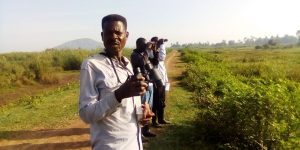
Within Kilimambogo lies Kyeleni, an unexplored agricultural village. On 20th February 2021, the Nature Kenya Youth Committee embarked on a two-day mission to survey the biodiversity in this area. (Kilimambogo is also known as Ol Doinyo Sabuk.)

Our journey to the village took longer than expected. Despite being exhausted from the three-hour drive, the team eagerly anticipated its visit, unsure of what to expect. Mr Francis, our contact person, greeted us by the roadside and directed us to the camping area, which would be our home for the next 24 hours.

Upon arriving at the campsite, the team was divided into groups to ensure cooking was completed early, to allow more time for the evening survey. The groups were: team Ugali (funny how energetic the members of this group were), team Stew (the best cooks in the group), team Firewood (in charge of lighting the fire), and team AOB (in-charge of cleaning the cooking pots after meals).

Francis gave some members of the group a tour of his farm as lunch was being prepared. In the middle of his farm, not far from the camping area, was the main attraction – a mango tree. You can only imagine the excitement of the hungry group upon seeing this tree. Francis allowed them to pick some mangoes. He even went out of his way to harvest some maize for the team to roast before lunch.

You would be mistaken to imagine that after feasting on mangoes and roasted maize, only a few people would show up for lunch. There wasn’t a grain of rice nor a drop of soup left in the pots!

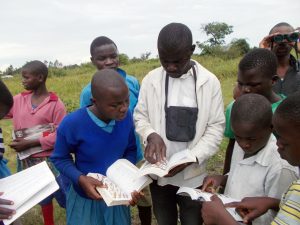
We converged at around 5 p.m. and went through some of the species present in the area, survey methods, and identification tools (iNaturalist, Makenya, and guide books) for use. We set out on our first survey, hoping to come across some interesting species.

Three hours into the search, we had spotted a few birds. Some of the birds had been identified by their calls. Darkness fell fast, and we retreated to the camping area.

After dinner, we gathered around a fire. The team was still going strong and decided to play a few games before calling it a night.

The following morning was chilly and quiet, with only the sweet melodies of birds heard. We started birding at 6 a.m. The bird experts in the group assisted the rest of the team with identification through calls. As the sun steadily rose higher into the sky, more birds became visible, making it easier to identify them.

Although no other species besides birds had been spotted hours into the survey, the herp and mammal lovers remained optimistic.

The day grew hotter, and we began to meet local residents who were puzzled as to why such a large group was in their village early in the morning. Francis explained that visitors from outside, particularly those interested in conducting research, were rare.

As we approached the foot of Mt. Kilimambogo, the team heard calls of excitement from within. “Come see a snake,” someone called.  The snake enthusiast hurriedly rushed to the scene to catch a glimpse of the snake while others moved further away. To their amazement, it was a Cape Wolf Snake. Unfortunately, it was dead. A few meters away, the group came across another dead one: an Olive Snake.

The two snake sightings were the team’s highest moments. This energized us for the rest of the hike to the base of the mountain.

This survey would not have been successful without the continued support of Nature Kenya. In total, we recorded 32 bird species, two amphibians, and two snakes, with the prominent plant species being Euphorbia, Croton trees, and Sisal.

Hope for Restoration

The ‘Tumaini la Urejesho‘ (Hope for Restoration) is currently airing on Amani FM, based in Garsen, Tana River Delta. The program seeks to inform and educates the public on forest landscape restoration (FLR) in Kenya, focusing on an ongoing project at the Tana River Delta. The project dubbed the Restoration Initiative Tana River Delta is supported by the Global Environment Facility (GEF) through the United Nations Environment Programme (UNEP). Nature Kenya is the executing partner. Listen in here

More resources:

The Restoration Initiative Year in Review 2019

How butterflies protect Arabuko-Sokoke Forest

March 3 is World Wildlife Day. The day was set aside by the United Nations (UN) to celebrate and raise awareness of wild animals and plants. “Forests and Livelihoods: Sustaining People and Planet” is this year’s theme. The theme highlights the central role of forests, forest species and ecosystems services in sustaining the livelihoods of hundreds of millions of people globally, and particularly of indigenous and local communities with historic ties to forested and forest-adjacent areas.

“It is all about the trees, the butterflies and my sweep net. The trees bring the butterflies and these butterflies earn me a livelihood,” says Abbas Athman, an Arabuko-Sokoke forest-adjacent dweller.

Athman has mastered the patience, calmness and agility to dart and flit with butterflies in one of the most rewarding businesses in Arabuko-Sokoke Forest: butterfly farming. He can tiptoe, then dart just like the butterflies before bringing them down with a swoop of his net. For 15 years, a sweep net and several indigenous trees dotting his compound are among his precious investments.

Athman neighbours Arabuko-Sokoke forest, the largest remnant of coastal forest in East Africa and a home to many endangered species, a reason why conservation of the forest is critical. However, pressure from the growing population in tandem with the soaring demand for wood fuel and building materials placed the forest in danger.

Enter the butterflies, unlikely saviours. The butterfly export project, which started in 1993 as an initiative by Nature Kenya and the National Museums of Kenya to conserve the forest, has brought together hundreds of farmers living around Arabuko-Sokoke forest. While conserving the critical ecosystem, the project boosts the livelihoods of farmers from across 50 villages around Arabuko-Sokoke who, in a good season, can each earn up to Ksh 15,000.

In the butterfly project, farmers trap adult butterflies and keep them in transparent cages made from nets. Within these cages are different types of trees, which are food for the caterpillars that will become butterflies.

The butterflies lay eggs, which hatch into larvae – caterpillars. The caterpillars feed on the leaves of forest trees, and grow until they turn into pupae. A pupa is a resting stage. Inside the pupa, the caterpillar changes into a butterfly.

Butterfly farmers collect the pupae and bring them to the Kipepeo office, where the farmers are paid for each pupa. The pupae are then exported to different countries where they become part of live butterfly exhibitions.

Exporting pupae does not reduce the butterfly species within the forest, since a butterfly can lay up to 120 eggs. Farmers usually have butterflies in excess and often release them.

The project, Nature Kenya’s Coast Regional Coordinator Francis Kagema said, has helped ease cases of destruction in Arabuko-Sokoke.

“The project has demonstrated to communities the importance of these forests and whenever there are cases of destruction, it is the communities who tip authorities on the case. The project has also demonstrated the importance of growing indigenous trees, a move which has boosted forest cover in the region,” Kagema said.

Protecting the trees for the butterflies has been key in conservation of endemic and endangered species of Arabuko-Sokoke, says Paul Gacheru, Nature Kenya species expert. The forest, he says, hosts six of the rarest and globally threatened bird species including Clarke’s (Kilifi) Weaver, Amani Sunbird, East Coast Akalat, Spotted Ground Thrush, Sokoke Pipit and Sokoke Scops Owl. Arabuko Sokoke is also home to the unique Golden-rumped Sengi (elephant-shrew), over 230 bird species and 250 butterfly species.

Last year when Covid-19 struck, butterfly exhibits closed all over the world, and exports stopped suddenly. Nature Kenya and some of its members provided funds to support the butterfly farmers with small loans and seeds to grow food. This helped them through the worst of the pandemic, and now butterfly exhibits are opening again – including Butterfly House at Fort Jesus, Mombasa.

Indigenous and Community Conserved Area to Safeguard Critical Ecosystems and Livelihoods in Yala Swamp

“It’s not enough to talk about development, what is the benefit of development to local communities? It’s about identity, it’s about ownership, it’s about rights, it’s about access, it’s about representation, it’s about involvement in decision making, it’s about values derived from wise use of resources, it’s about fairness and equity in distribution of benefits accrued from investments, it’s about taking charge to ensure sustainability, most of all, it’s about perpetuating our heritage,” said Thomas Achando, the recently elected Chairperson of the Yala Swamp ICCA management committee who also sits in the Luo Council of Elders.

Yala Swamp, located on the north-eastern shore of Lake Victoria, is a Key Biodiversity Area and a proposed Ramsar site – a wetland of international importance. For thousands of fisherfolk and farming communities who depend on it, it’s their “gold”, as they fondly call it. Over the last few decades, there has been a significant decline in the abundance of natural resources due to a number of threats, including over-exploitation, encroachment, habitat degradation, climate change and high levels of poverty.

Through a multi-stakeholder approach, Nature Kenya worked with local communities and the Siaya and Busia county governments to develop a Land Use Plan (LUP) to balance the various interests and address the threats to the wetland. To kick start the implementation of the LUP, multi-agency stakeholders with support from Nature Kenya established an 8,404ha Indigenous and Community Conserved Area (ICCA) at the heart of Yala Swamp.

The ICCA constitutes natural areas surrounded by open-access farming and grazing land, riverine forest and papyrus wetland. Guided by a management plan with technical backstopping from the government, the ICCA will be managed for multiple-use for the benefit of important cultural values and biodiversity, as well as ecotourism, farmers, livestock herders, fisherfolk and island dwellers. The ICCA will guarantee a continued flow of ecosystem services to enable production and ensure development overall is sustainable.

“Those are the striking features about the Yala Swamp ICCA model. I’m happy to take up leadership that will deliver the vision for local inhabitants of Yala Swamp through a balanced all-inclusive approach”, says Achando.

Meanwhile, Yala Ecosystem Site Support Group, the local community conservation champions, have intensified awareness campaigns to rally support for the LUP and ICCA through chief’s barazas and on vernacular radio station Bulala FM, in Budalang’i, Busia County. The forums have been quite instrumental for community members to ask questions, seek advice and clarification and allay fears held by local community members.

“When I received news about a meeting from my village elder with the agenda being our swamp, I was disturbed. Issues concerning Yala swamp have always been jinxed, from history, so I hardly slept at night. I was anticipating the worst, my intuition told me that we were going to lose our rights to access land for subsistence farming, because who cares about the vulnerable?” said one elderly woman from Usonga, Siaya county, during a sensitization meeting at Mlambo village in early January 2021.

“We are thankful for the information we’ve been provided with. Through the Land Use Plan we have a roadmap to finding lasting solutions for issues affecting Yala swamp. I can’t wait for the County Assemblies to give their nod of approval for the Yala Swamp Land Use Plan,” added the elderly woman.

To enhance ownership of biodiversity conservation at the village level, Nature Kenya is supporting formation of Village Natural Resource and Land Use Committees (VNRLUCs) in all the swamp-adjacent villages. VNRLUCs will facilitate governance, conservation and development actions and diversify sustainable livelihoods in line with the ICCA model.

Promoting sustainable livelihoods to conserve the Tana River Delta

The lush, green fields make it difficult to imagine the calamities that Idsowe village within the vast Tana River Delta experiences whenever floods or drought strike.

The Tana River Delta is a land of alternating flood and drought. In the old days, people moved when disaster struck. This is no longer feasible. So today, farmers and pastoralists are adopting ambitious climate-smart agriculture projects geared towards improving livelihoods, resilience to climate change, and conserving the 130,000-hectare Tana River Delta.

Tana River Delta is one of the most important wetland ecosystems in East Africa. The Delta spreads out to cover parts of Tana River and Lamu counties, comprising of flood plains, riverine forests, mangrove systems, savannas, grasslands, lakes and pristine beaches, that form a network of natural and productive areas like Idsowe.

With over 350 species of birds, including globally important large flocks or “congregations”, Tana River Delta is a Key Biodiversity Area and a Ramsar site (wetland of international importance). Tana River Delta is also home to two globally endangered monkeys: the Tana River Red Colobus and the Tana River Crested Mangabey.

When undisturbed, the Delta acts like a sponge, absorbing floods, storing water, something that makes it lush and green even during the dry season. Today, with climate change increasing the severity of droughts and floods, and people unable to move elsewhere, Tana Delta is experiencing challenges. This is the reason why ambitious initiatives like chilli farming, bee-keeping, fish ponds and mainstreaming of climate-smart agriculture in production systems are taking root under the REBUILD project.

The project seeks to contribute towards increased resilience of communities in arid and semi-arid land (ASAL) areas of Kenya to drought and other effects of climate change. This is done through enhancing food and nutrition security of vulnerable households, especially for women and children, generating sustainable livelihoods and protecting productive assets in Tana River County. Funded by the European Union (EU), the REBUILD project is implemented by CISP in collaboration with Nature Kenya, the National Drought Management Authority, GROOTS and Procasur.

“Part of solving the problems the Delta residents are facing is mainstreaming climate-smart agriculture. Farmers can choose crops that withstand the changing climate to boost their production. Livestock farmers can choose the right breeds to boost productivity while minimizing the negative impact on the environment,” says Nature Kenya Executive Director Dr Paul Matiku.

“For the first time, our group comprising of 133 members tried out chilli farming after Nature Kenya provided us with the seeds,” says Milcah Amaro, the chairperson of Harakisa group. “Thirty-five active members planted chilli in quarter-acre plots on their farms in July 2019. By December that year, the crop was ready for the market. In a good month, one can make between Ksh 12,000 to 15,000,”.

Despite frequent floods that have been ravaging the delta and flooding farms, Harakisa Group members continue to prepare parcels of land away from the previous fields for chilli farming.

“Previously, we used to farm crops like maize, but the production kept dwindling. Coupled with frequent floods and droughts, it became difficult to cope until chilli farming came along. This has since reduced dependency on forest products, especially trees, where some people had resorted to cutting trees and burning charcoal to earn a living,” says Dorcas Helbon, a chilli farmer.

Ismael Komoro from Handaraku says the introduction of the Galla goat breed is a step towards improving productivity for goat farmers. Nature Kenya has distributed 180 male Galla goats.

“Unlike the breed we have, Galla goats are big, meaning a farmer can get more profit by keeping a few goats of this breed,” Komoro says. Having fewer but more productive goats also means less pressure on the Delta, hence less degradation.

Residents on the lower side of the Tana Delta, in Ozi and Mpeketoni villages, are conserving mangroves and dryland forests as they engage in rice and fish farming. The fish farming project is supporting fourteen fish ponds in Ozi.

“Fish farming in Ozi will solve challenges of overfishing within the mangroves, which are fish breeding zones,” says George Odera, Nature Kenya’s Tana Delta project manager. “A lot of fishing has been going on in the mangrove areas as most local fishers cannot access the deep sea due to lack of proper gear. Fish farming in ponds will give a lifeline to these communities while also conserving the critical mangrove forests and breeding zones.”

“Nature Kenya previously supported us with fingerlings to restock our six ponds. The Department of Fisheries stepped in to train us on how to make feeds. Fishing is now manageable for the 50 farmers under this group. In July we harvested 2,400 kilograms of fish which we sold for Ksh. 200 a kilo, translating to Ksh. 480,000,” says Abdallah Hassan Mohammed, the secretary of Moto Fish farmers in Ozi.

For farmers in the Delta, getting certified seeds has been one of their biggest challenges. Nature Kenya has stepped in to distribute certified seeds and incorporated extension officers who visit farmers to enhance mainstreaming of climate-smart agriculture in production systems.

Rice farming within Ozi and Mpeketoni villages received a boost after 247 farmers received 4,720 kilogrammes of rice seed. Farmers expect to boost their production while conserving the critical mangrove and dryland forests.

“Although we are yet to harvest, we can see the difference of the certified seeds distributed by Nature Kenya from the ones we normally plant. They are also fast-maturing,” says Godhana Chalalu Dhadho, a rice seed beneficiary.

Mary Mwende, a beneficiary of climate-smart agriculture training, says the introduction of certified maize seeds in Hurara in Tana Delta has boosted productivity within the area.

“Initially, we thought it was cheaper getting seeds from the old harvest, a situation which resulted in poor production. The latest harvest from the distribution of certified seeds yielded double of what we used to harvest. From the initial three bags we used to harvest from an acre, we currently harvest between 8 to 10 bags,” Mwende says.

Farmer field schools have also been set up, with one being at Minjila near Garsen to enhance mainstreaming of climate-smart agriculture. Farmers can walk in and learn best farming practices to adapt to the changing climate.

Nature Kenya is also implementing another project in Tana River Delta: The Restoration Initiative (TRI) Tana Delta. This project, funded by the Global Environment Facility (GEF) through the United Nations Environment Programme (UNEP), aims at restoring degraded forest landscapes in Tana River and Lamu counties.